Showing posts with label Break-fast. Show all posts

Tuesday, August 16, 2011

Egg Roast in Kerala Style


Egg Roast is a famous Kerala egg dish. It is usually a bit on the spicier side and enjoyed with palappam or porottas or chappatis.

Ingredients
  • 4 hard boiled eggs
  • 4 large onions sliced very thinly
  • 1 tbsp of ginger-garlic paste, coarsely ground
  • 1 large tomato finely chopped after removing the skin by blanching the tomato in boiling water for a few seconds. Use ripe tomatoes so that they are not sour.
  • 1½ tsp of coriander powder
  • 1½ tsp of Kashmiri chilly powder
  • 1 tsp of garam masala (Grind 1” piece of cinnamon, ½ tsp of aniseed, 3 cloves, 2 pods of green cardamom)
  • 1 tsp of black pepper powder (reduce this amount if you want a less intense flavour of the black pepper)
  • 4 dessert spoon of vegetable oil
  • 1 sprig of curry leaves
  • Salt as required
  • ½ cup of water
Method
  • Take a kadai and heat the oil
  • Once the oil is hot, add the ginger garlic paste and sauté it for a couple of minutes on low flame
  • Add the sliced onions and sauté the onions till they turn golden brown (slightly on the darker side)
  • Move the onions to one side of the pan and add a little more oil if needed, so that there is sufficient oil in the center of the kadai. There should be at least 1 tbsp of oil at the center of the kadai
  • Mix the masala powders into a thick paste by adding a little water
  • Add the masala powder mix to the oil and sauté the masala for a minute
  • Now mix together the onions and sauté for a couple of minutes more
  • Add the curry leaves and then the tomato
  • Sauté on medium heat till the oil seperates. This could take a few minutes.
  • Add the water a little at a time, so that you have a thick gravy.
  • Add salt as per need
  • Add the boiled eggs after putting gashes on the eggs
  • Cover and cook for 5 minutes
Serve with palappam, Kerala porotta (Malabar Paratha) or chappati.

Wednesday, March 9, 2011

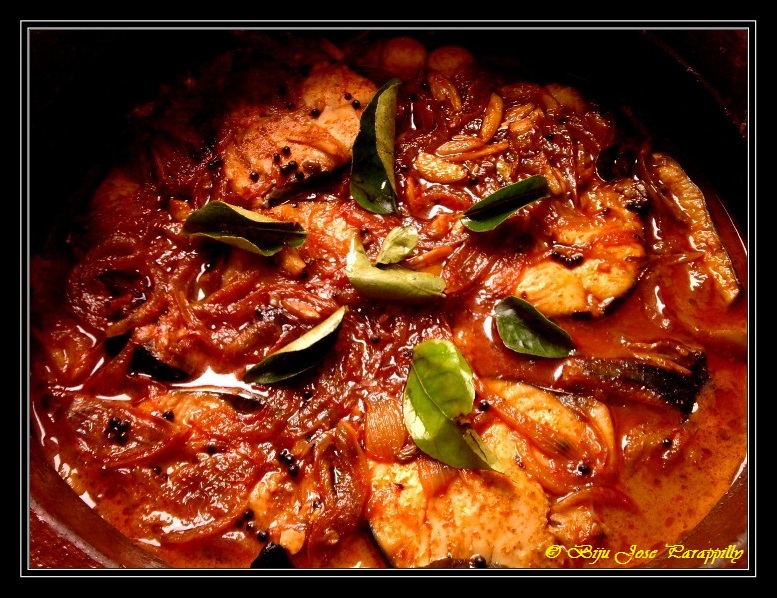
Kerala Red Fish Curry and Tapioca (Kappa)

I love fish. I love fish in any form. I love them in the water, happily wagging their tails and darting from one place to another. I used to enjoy going to the big canal near my house. Go and sit on the steps. Dangle your feet in the water. And in a few minutes you will find fishes of varying shapes and colours sizing you up. Then the braver ones get closer. At some cue, they will jump at your toes and start nibbling them. They start eating you alive. And it is a funny feeling. Thank God there are no pirahnas in there. You wriggle your toes and the fishes scurry away.


My wife would run away from the fish. She was brought up in a city and did not have any encounters with them. Moreover she iss from a Brahmin family who essentially were vegetarians. But then I got lucky and she agreed to marry me. Poor little girl had no idea what she was getting into.


I would take her out to the vegetable market. I will then guide her towards the fish market as if I did not even know that it existed. I know we are near the fish market by studying her nose. It acted like a proximity sensor for me. I would act innocent and will be wondering aloud "How the hell did we end up at the fish market?" I would then go onto buy some fish. She would be standing far off. She would run away from the kitchen screaming when I bought in fish. So I would get live crabs and let them loose in the house. She would be jumping up and down the bed, screaming her head away. I would then go about cooking the fish and the crabs and the mussels and eating them while she would nibble on grass (spinach and such) and vegetables. She would recoil at all the crackling noises that I generate while attacking the cooked crabs.


Time heals everything. Well slowly (it took a while) my wife gathered the courage and mental stregth to confront the creatures of the water. She actually astounded me by going into the fish market. And not only that. She would poke a finger into the fish to see if it was fresh. Not satisfied, she would actually open the side of the fish to study the gills.

These dishes have been cooked by my wife. Though she is a vegetarian, she has learned to cook non-veg stuff and cooks them very well, without even tasting them. So I do not have to spend time to cook these things now. Also she has mastered most of the Kerala dishes, though she is not a Keralite. Examples are below.

I consider myself very lucky that she is my life partner.


Kerala Red Fish Curry


This dish is supposed to be very hot. But you can adjust the degree of hotness according to your taste by using Kashmiri Chilly powder and by avoiding the green chillies. This also goes very well with steamed white rice/brown rice. This dish also has slight variations in different parts of Kerala.

Ingredients

  • Coconut Oil - 3 tablespoons. Use any other cooking oil if you are not comfortable with using coconut oil for cooking.
  • Mustard Seeds - ½ teaspoon
  • Fenugreek Seeds - ¼ teaspoon
  • Curry leaf - 2 sprigs
  • Green Chilly - 2 slit lengthwise
  • Ginger - 1" piece, thinly sliced
  • Garlic - 10-12 cloves, cut into two pieces each
  • Shallot - 1 cup, sliced thinly
  • Chilly Powder - 2 tablespoons
  • Turmeric - ¼ teaspoon
  • Kudampuli (Malabar Tamarind) - 3-4 pieces
  • Salt as per taste
  • Fish Fillets (Kingfish, Pomfret, Indian Salmon, Sardine, Mackerel etc.) - ½ kg
Method
  • Heat a pan and add the oil.
  • Once the oil is hot, add the mustard seeds and fenugreek seeds
  • Once the seeds splutter, add the ginger and garlic and fry for 1 minute
  • Add the curry leaves
  • Add the sliced shallots and fry till they are translucent
  • Add the green chillies
  • Mix the chilly powder and tumeric powder with a little water to form a thick paste. Add this to the pan. Fry the masala for about 2 minutes
  • Add a cup of water.
  • Once the mixture boils, add the fish and the malabar tamarind and salt.
  • Reduce the flame to a simmer and cook for 8-10 minutes
  • Take off from the stove and let the dish stand for 5-6 hours before using it.
Information & Tips
  • You can find what Malabar Tamarind is here. This is usually available in Kerala Stores (for those who stay outside of Kerala) and is available in most of the shops in Kerala. If you cannot find this, you can substitute this with kokum or tamarind pulp. But the taste will not be the same. This is one of the most important ingredients of this dish, that gives it its signature flavour.
  • Shallots are also called small onions, sambhar onions etc. and are widely available in South India. You can substitute it with normal onions.


  • Tapioca - 1 kg
  • Coconut oil (or any other cooking oil) - 3 tablespoons
  • Mustard seeds - ½ teaspoon
  • Turmeric Powder - ½ teaspoon
  • Curry leaf - 2 sprigs
Coarse Paste
  • Curry leaf - 2 sprigs
  • Coconut - ½ of one coconut
  • Sliced shallots - ½ cup
  • Sliced Ginger - 1" piece
  • Green Chilly - 2
Grind this to a coarse mixture without water. It should have the consistency of grated coconut.

Method

First Part
  • Clean the tapioca and cut into small bite-sized pieces. Clean it thoroughly.
  • Boil water in a pan and add some salt to it. Add the tapioca pieces and boil for 3-4 minutes. Drain the water off.
  • Add fresh hot water again and boil the tapioca till it is cooked. Drain off the water completely.
Second Part
  • Heat oil in a pan and once the oil is hot, add the mustard seeds.
  • Once the mustard seeds splutter, add the curry leaves and then the coarsely ground coconut mixture. Saute this for 3-4 minutes on medium flame.
  • Add salt and then turmeric.
  • Then add the tapioca and turn the flame to low heat
  • Mix everything well and cook for 3-4 minutes.
Serve with the fish curry made earlier.


Saturday, March 5, 2011

Velvetty Egg Spread


Substitute olive oil with normal vegetable oil and parsley leaves with coriander leaves if you cannot find these ingredients. Parsley leaves give it a very unique flavour. You can
also add mixed Italian herbs to the egg.


Ingredients
  • 3 eggs
  • 1 green chilly finely chopped
  • 2 tbsp of parsley leaves chopped
  • Salt as per taste
  • Black pepper powder as per taste
  • 50 gm amul butter
  • 3 tbsp of fresh thick cream
  • 1 tbsp of olive oil
Method
  • Take a thick bottomed saucepan
  • Place it over the stove and add the oil
  • Once it is slightly hot, take it off from the stove
  • Break the eggs into the pan
  • Add the butter
  • Return the saucepan to the stove and keep stirring the egg with a spatula in a circular motion (like whisking the egg, but at a much slower pace)
  • After about 20-25 seconds, take the pan off the stove and keep mixing the egg mixture
  • Repeat the above two steps for about 2-3 minutes
  • Midway through the above process add the cream to the egg
  • Add the parsley leaves, salt (use very little salt since we have added salted butter), minced green chilly and pepper powder just before you take the dish off the fire for the last time
  • When finished the consistency should be like mayannoise. Spread it over toasted bread, or chappati


Poached Egg


Not sure how many of you have had poached eggs for breakfast. Poached eggs are great to have with bread slices or all by itself or in combination with a lot of other stuff like salami, bacon etc.

Making a poached egg is quite a simple but delicate task.

Ingredients

  • One egg
  • I tbsp of salt
  • 2 tbsp of vinegar
  • Black pepper powder
  • Salt as required
Method
  • Break the egg gently into a glass bowl/ceramic bowl without breaking the yolk
  • Take one wide deep flat bottomed steel vessel and add water to fill it upto the half level
  • Bring the water close to its boiling point but make sure the water is not boiling
  • Add 1 tbsp of salt (add salt depending on the quantity of water)
  • Add the vinegar
  • Stir the water along the edge of vessel in a circular motion to form a whirlpool kind of motion
  • Slowly slide the egg from the glass bowl along the direction of the water flow into the water
  • You can gently fold the white over the yolk if needed using a fork (this is actually not required)
  • Cook for around 2.5 to 3 minutes
  • Take the egg out with a slotted spoon
  • Sprinkle salt and black pepper powder over the egg (you can add other spices if needed)
  • Serve over a slice of toasted bread or a bed of salami/bacon.
When you cut open the egg, the yolk should flow out and spread over the bread slice. There you have it, a perfect poached egg. If this is cooked too much, the yolk would harden. And that is not considered a perfect poached egg.