Showing posts with label Main Course. Show all posts

Friday, March 6, 2015

Paneer Bhurjee (Scrambled Cottage Cheese Curry)


Paneer or cottage cheese is to vegetarians what chicken/fish/mutton is to non-vegeterains in India. And the fact that you can make cottage cheese very easily at home with full cream milk is an added advantage. Paneer should always be fresh and soft. My wife usually makes this at home whenever we are in the mood to have a paneer dish. You can see several online tutorials about how to make paneer at home. The health conscious among you, can substitute paneer with tofu. However the taste of the dishes would not be the same. So go ahead and indulge in paneer once in a while.

We made this dish today. Since my wife is a vegetarian, I hop to add more and more vegetarian recipes to this blog as we make them.
Ingredients
  • 200 gram fresh paneer grated/crumbled
  • 1 large onion finely chopped (add more onion to increase the quantity of the dish)
  • 1 tbsp finely chopped garlic
  • 1 tsp chopped ginger
  • A pinch of asafoetida
  • 1 tsp whole cumin seeds
  • 2 green chillies finely chopped
  • 1 large tomato finely chopped
  • ½ cup thick cream
  • ½ tsp of dried fenugreek leaves, crushed into a fine powder
  • 2 tbsp of chopped fresh coriander leaves
  • 2 tbsp vegetable oil
  • 1 tsp paav bhaji masala
  • ¼ tsp turmeric powder
  • ½ tsp red chilly powder
  • Salt as per taste
Method
  • Heat the vegetable oil in a pan.
  • Lower the flame and add the asafoetida and whole cumin seeds to the hot oil
  • After a few seconds, add the finely chopped garlic and sauté the garlic until they turn slightly brown but not burnt. Add the finely chopped ginger after sautéing the garlic for a few seconds.
  • Add the finely chopped onion and sauté them until they caramelize but are not burnt
  • Add the paav bhaji masala, turmeric powder, red chilly powder and a tbsp. of water
  • Sauté the masala for a minute
  • Add the finely chopped tomato and sprinkle some water over it. Cover and cook, stirring occasionally until the tomato becomes mushy and the oil separates from the masala.
  • Add the crumbled paneer and mix everything well
  • Add salt as needed
  • Cook this for a couple of minutes and then add the cream. Mix everything well
  • Cook further for two minutes.
  • Sprinkle the dried fenugreek leaf powder and then add the chopped coriander leaves
  • Serve hot with naan or roti
Notes
  • The final texture should not be dry but a little wet. So add the cream (you can also add plain milk instead of cream)


Laal Maas - Rajasthani Red Meat Curry


Laal maas is a traditional meat curry of Rajasthan. This used to be made during the hunting expeditions using the meat of the animals that were hunted. Today it is made mostly using mutton. Since this used to be cooked while on hunting expeditions, most of the spices used for this used were the dry ones along with onions and garlic. So no curd, tomato etc. were used in this recipe. Even though I have used green chillies, I guess perhaps even those would not have been part of the original recipe. These days however, most of the recipes you find online use curd and tomato. And they all omit a very special ingredient of this dish which is dried Kachri powder. Kachri is a type of cucumber that grows in the wild, in some parts of Rajasthan. They are bitter when raw and sweet and sour when ripe. These are dried in the sun and then powdered and used for meat dishes. The dried powder has a very distinct flavour and is a combination of bitterness and sourness, depending on the state of Kachri (raw or ripe) when dried. It tenderizes meat and imparts a unique flavour to it. Dried Kachri is also used to make chutney in Rajasthan. You can find more about Kachri here.

We went visiting Jaipur in Rajasthan during Dec 2014. And obviously I was after this dish. I tasted it at a couple of restaurants. I am not sure how authentic they were. My next goal was to buy Kachri powder. So I ended up at the Chaandpol market in the Pink City area that has many wholesale shops selling spices. And finally I found dried Kachri at one of the shops and bought half a kg of it for Rs. 60.

I have tried to find a non-vegetarian Rajasthani friend who could get me the original recipe of Laal Maas. Unfortunately all my Rajasthani friends are vegetarians. So I continue to look for an authentic version of this recipe. Given below is a version that I have tried based on the various recipes found online. The outcome was very good. It had a very different flavour compared to the other mutton recipes and I loved it.

Ingredients
  • 2 large onions, finely chopped
  • 2 green chillies, finely chopped
  • 18-20 whole red Kashmiri chillies (reduce the number if you want this to be less spicy or increase the number to make this extra spicy. But remember that this is one of the most important ingredient of this recipe and should be used generously)
  • 2 tsp coriander seeds, whole
  • 1 tsp jeera or cumin seeds
  • 3 tbsp mustard oil
  • 1 tbsp of garlic, finely chopped.
  •  1 tsp of ginger, finely chopped
  • ½ kg mutton or lamb, cut into pieces with bones
  • Salt as per taste
  • 3-4 tbsp of kachri powder (There is no substitute for this that I can think of)
  • 3-4 pods of green cardamom
  •  ½ tsp whole black pepper
  • 1" piece of cinnamon stick
  • A little bit of mace
  • 1 pod black cardamom
  •  Water
  • A handful of coriander leaves, chopped (optional)
Method
  • Dry roast the red chillies until it gives out a distinct aroma. This is a very important step of this recipe.
  •  Add to that the coriander seeds and cumin seeds and dry roast them until their aroma is released. Make sure not to burn these while dry roasting. Always dry roast on low heat and continuously stir the contents.
  • Once done, cool and grind them into a nice fine powder.
  • Heat the mustard oil in a pan. Bring it to its smoking point and then reduce the heat.
  • Add cinnamon, black pepper, green and black cardamoms and mace. You can lightly crush the green and black cardamoms before adding them to the oil.
  • Add to this the garlic and ginger.
  • Once the garlic turns slightly brown add the mutton/lamb pieces and salt and turn the heat high.
  • Add the Kachri powder and then turn the pieces frequently until the pieces have browned on all sides.
  • Remove the mutton pieces to a plate and keep aside.
  • Reduce the heat and add the chopped onions and mix all well. Add more mustard oil if required.
  • Once the onions have browned (take care not to burn them), add the mutton pieces back to the pan.
  • Add the ground red chilly powder and roast it for a couple of minutes.
  • Add enough water to cook the meat. Cover and cook until the meat is cooked. (I used a pressure cooker and cooked the mutton at this stage for about 15 minutes after full pressure was achieved.)
  • Add about half a cup of hot water if needed so that you have a slightly thick gravy.
  • Continue to cook it and when you reach a good consistency of gravy, turn off the heat.
  • Add the chopped coriander leaves (if using)
  • Serve hot with naan, roti or rice.
Note
  • If you so wish, you can grind into a fine powder the whole spices except mace and add that to the mutton while browing the mutton.


Sunday, March 1, 2015

Malvani Masala Prawns


Ingredients

For the Marination
  • Salt as per taste
  • 1 tsp of fresh lemon juice
For the Paste
  • 2 tbsp of vegetable oil
  • 5-6 Whole Kashmiri Red Chillies broken into smaller pieces (For a spicier version, use only whole Sankeshwari red chillies or a mix of Sankeshwari red chillies and Kashmiri red chillies).
  • ¾ cup of grated dry coconut
  • 2 tbsp of whole coriander seeds
  • ½ tsp of cumin seeds
  • 3 green cardamoms
  • 2 medium sized onions thinly sliced
  • One inch stick of cinnamon
For the Malvani Masala Powder
  • 2 whole Kashmiri Red Chilly
  • ½ tsp of whole coriander seeds
  • 1 clove
  • 3-4 whole black peppercorns
  • A pinch of fennel seeds
  • A small pinch of cumin seeds
  • A pinch of caraway seeds (Shahi jeera)
  • 1 black cardamom
  • 1 inch stick of cinnamon
  • 2 stone flowers (dagad phool)
  • 2-3 nagkeshar
  • A pinch of mustard seeds
  • A small piece of dried turmeric (or directly use a pinch of turmeric powder while making the powder without dry roasting it first)
  • A pinch of asafoetida
  • A pinch of nutmeg
  • 1 star anise
Other Ingredients
  • 400 gms of cleaned and deveined prawns
  • 3 tbsp of vegetable oil
  • 1 tsp of cumin seeds
  • 2 sprigs of curry leaves
  • 1 large onion finely chopped
  • 2 medium sized ripe tomatoes finely chopped
  • ¼ tsp of turmeric powder
  • 1.5 to 2 tbsp of Malvani garam masala
  • Salt as required
  • ½ cup of thick coconut milk
  • 2 tbsp of chopped fresh coriander leaves
Method
  • For Marination
    • Wash and pat dry the prawns
    • Marinate the prawns with salt and lemon juice and refrigerate for 30 min
  • For the Paste
    • Dry roast the whole red chilly, coriander seeds, cumin seeds, cinnamon and green cardamom on a hot pan on low heat until their aroma is released. Transfer them to a plate to cool.
    • Dry roast the grated dry coconut on a hot pan on low heat until it becomes light golden in color. Transfer it to a plate to cool.
    • Heat 2 tbsp of oil in a pan and sauté the sliced onions until they caramelize and turn a light golden brown color. Transfer it to a plate to cool.
    • Once all the ingredients are cooled down, grind them to a fine paste using a mixer grinder. Use water as required so that you get a fine thick paste.
  • For the Malvani Masala Powder
    • Dry roast all the ingredients one by one on a hot pan on low heat until their aroma is released. Cool them and then grind into a fine powder. This should make about 1.5 to 2 tbsp of powder.
  • Heat 3 tbsp of oil in a deep pan.
  • Once the oil is hot, reduce the flame add the cumin seeds and after they splutter add the curry leaves.
  • After a few seconds, add the chopped onion and sauté them until it turns light golden brown
  • Add the chopped tomatoes and cook them until the tomatoes turn pulpy.
  • Add the turmeric powder and the ground masala and the Malvani garam masala
  • Add salt as required
  • Cook the mixture on a low heat until the oil separates from the masala
  • Add the prawns and mix everything well. Cover and cook for 3-4 minutes or until the prawns are perfectly cooked. Overcooking the prawns will make them hard. Hence take care not to overcook them.
  • Once the prawns are cooked, add the coconut milk and mix everything together and cook for another two minutes
  • Adjust salt as required.
  • Remove the pan from the stove and add the chopped coriander leaves.
Serve hot with white rice, appam, neer dosa etc.


Sunday, November 23, 2014

Mutton Masala


Ingredient Set A – To be dry roasted and ground
  • Black cardamom – 2
  • Green cardamom – 5
  • Clove – 4
  • Black pepper – 1 tsp
  • Black cumin seeds (Shahi Jeera) – 1 tsp
  • Cumin seeds – 1 tsp
  • Whole coriander – 2 tbsp
  • Nug meg – a small piece
  • Mace – 1 full
  • Dried bay leaf – 2
  • Cinnamon – 1.5” piece
  • Poppy seeds – 2 tbsp
Dry roast the above ingredients without any oil until the aroma is released. Cool and then grind them into a fine powder.

Ingredient Set B
  • Vegetable oil – 4 tbsp
  • Finely sliced onion – 4 large numbers
  • Finely chopped red tomato – 3 large numbers
  • Curd – 1 cup (curd should not be sour)
  • Water – 2 cups or as required
  • Green chilly slit lengthwise – 2
  • Kashmiri red chilly paste – 3 tbsp (You can substitute with 3 tbsp of Kashmiri red chilly powder mixed with a little water)
  • Ginger garlic paste – 2 tbsp
  • Chopped mint leaves – 2 tbsp
  • Chopped coriander leaves – 2 tbsp
  • Salt as required.
  • Mutton cubes with bone – 1 kg
Method
  • Heat a large skillet or kadai and add the oil
  • Add the sliced onions and sauté them until they are translucent and begin to turn golden brown
  • Add the washed and drained mutton cubes to the onions and over medium high heat sear them in the oil – cook them this way for about 10 minutes turning them around after every minute or so.
  • Move the mutton pieces and onion to the sides of the skillet and add the ginger garlic paste into the oil at the center. Sauté the ginger garlic paste for about a minute in the oil. And then mix the ginger garlic paste with the mutton pieces and continue cooking for another 5 minutes.
  • Add the red chilly paste and then cover and continue cooking for another 5 minutes.
  • Add salt as per taste at this stage.
  • Now add the garam masala powder prepared earlier (Ingredient set A)
  • Now add the chopped tomatoes and then cover and cook for another 10 minutes or until the tomatoes are fully cooked and have become mushy and the oil is separated from the masala
  • Add the curd, chopped mint and coriander leaves and cover and cook for another 5 minutes
  • Add sufficient boiling water and then cover and cook over low flame for another 25 – 30 minutes or until the mutton pieces are tender and the gravy has the desired thickness.
  • Adjust salt as required.
  • Serve hot garnished with chopped coriander leaves along with rice or naan/roti. The dish would have a rich dark red color and velvety gravy.

I have not added any garnish since the curry looked so beautiful without any garnish.


Sunday, May 8, 2011

Dal Makhani


Ingredients

  • Whole black lentil (Sabut urad dal) - 250 gm
  • Ghee/Oil - 4 tbsp
  •  Asafoetida (Hing) - one pinch
  • Onion chopped - 1 large
  • Tomato chopped - 2 medium
  • Chilly powder - ½ tsp
  • Turmeric powder - a small pinch
  • Coriander powder - ¼  tsp
  • Everest garam masala - 1/2 tsp
  • Salt to taste
Make a coarsely ground/crushed paste of the following
  • Green chilly - 1
  • Jeera - 1/2 tsp
  • Garlic crushed - 10 cloves
  • Ginger crushed - 1" piece

 Method
  • Soak the black lentils for 30 minutes in water. (3 cups of water for 1 cup of dal). Drain the water.
  • Pressure cook the lentils with 3 cups of water for about 12 minutes (or until it is done). Bring the pressure cooker to full pressure and then lower the flame and let it cook. After about 12 minutes switch off the flame and then let it cool naturally. Once the pressure is completely released, check if the dal is cooked. If it is not, cook for a few minutes again. Open and mash the contents in the cooker slightly.
  • Heat a pan and add the ghee/oil
  • Add the  asafoetida
  • Add the crushed ingredients and saute for about 2 minutes
  • Add the onion and saute till they turn translucent
  • Add the turmeric powder, chilly powder, coriander powder and garam masala (Everest garam masala)
  • Add the chopped onions
  • Saute till the masala is cooked
  • Add the ingredients of the cooker
  • Add water if required (the gravy should be of pouring consistency)
  • Cook for about 10 minutes
  • Add salt and coriander leaves
  • Add a dollop of butter before serving (in that case add a little less salt in the beginning)
This tastes best when it stands for a couple of hours at least after cooking. Serve with hot naans.

Usually people also add one/two tablespoons of kidney beans (rajma) along with the black lentils. You can also add 3-4 tbsp of fresh cream after cooking.


This has been cooked by my wife who is a vegetarian and this is a favourite dish of many vegetarians. This is a very popular Punjabi dish.

Tuesday, April 26, 2011

Prawns Gassi


This is one Konkani/Mangalorean dish that I love. Simple to make and yet very delicious. Again, I hope this recipe is authentic. However if some friends from the Konkan coast could give their seal of approval or give the correct version of the recipe, it would be really nice.

Ingredients
  • Prawns - 500 gm (weight after cleaning and deveining)
  • One medium sized onion, finely chopped
  • 3 tbsp oil (coconut oil preferred)
  • 1 sprig of curry leaves (optional)
  • Salt, as per taste
  • Pulp extract of 1½ tbsp of tamarind (take a lemon sized tamarind ball and add it to a bowl of lukewarm water. Strain it after about 15 minutes)
  • Prawns stock/water, 2 cups
Masala Paste
  • Roasted whole Kashmiri red chillies - 10 to 15 (depending on how spicy you want it to be)
  • One medium sized onion thinly sliced
  • 2 tsp of roasted whole coriander (you can substitute with coriander powder)
  • ¼ tsp of fenugreek seeds
  • ½ tsp of turmeric powder
  • 1 tsp cumin seeds
  • 10-12 black peppercorns
  • 1 cup grated coconut (half of one medium sized coconut)
  • 8-10 garlic cloves
Grind the above into a fine paste using a little water.

Method
  • Clean the prawns and mix it with salt and set aside for a while (15-20 minutes)
  • Take a pan and add the oil
  • Once the oil is hot, add the curry leaves (optional)
  • Add the chopped onions and sauté till the onions turn slighly brown
  • Add the ground masala and fry it on medium heat till the whole mixture turns brown and the oil seperates from the masala
  • Add the tamarind extract as needed (keep tasting it so that you do not add too much or too little)
  • Add 2 cups of prawns stock or water
  • Once the mixture boils, add the prawns and salt and reduce the flame
  • Cook the prawns for about 5 minutes
Prawns stock
  • If you are buying fresh prawns, keep aside the shells, except the head, while cleaning them.
  • Wash the shells well and add them to a pan with 3-4 cups of water
  • Boil the mixture and then turn it to simmer and let it simmer for at least an hour
  • Remove the scum that may form at the top
  • Strain and you have the prawns stock. If you have excess stock, store them in the freezer and use them as required for soups and other preparations of prawns.
This goes well with white rice or naan.


Wednesday, March 9, 2011

Fish Molee

Fish Molee (Fish in Coconut Milk) ഫിഷ്‌ മോളി
This is a typical Kerala dish which is very simple and yet mouth-wateringly delicious. This is not spicy and so even children will enjoy this. This goes extremely well with appam, white bread and rice. If you search the internet for this recipe you will find at least 4-5 different variations of the same recipe. I have tried most of them and also the method that my father uses to cook this. I am describing below the basic recipe which in itself is complete. I shall also explain the variations you could try. After all, cooking is about being creative and finding a taste that you like most. So try the different variations and settle down for what you like most.

I was not able to find out how this dish got its unique name.

Ingredients
  1. Fish Fillets - 500 gm. You can use fish fillets or a whole fish like a pomfret (silver or black) or a pearlspot (karimeen) etc. Use any fish with white flesh (preferably sea water fish) without a very strong flavour of its own. In the above dish I have used Basa fish fillets.
  2. Onion - 1 cup. Two large onions thickly sliced.
  3. Ginger - 1 tablespoon. Cut into thin juliennes and slightly crushed.
  4. Garlic - 10 cloves. Cleaned and slightly crushed.
  5. Green Chilly - 3 No. Slit lengthwise and deseeded. Use more green chilly if you want to make this spicy.
  6. Curry Leaf - 1 sprig.
  7. Tomato - 1 No. 1 large tomato cut into 8 wedges.
  8. Turmeric Powder - ¼ teaspoon.
  9. Vegetable Oil - 2 tablespoon. Use coconut oil for more authentic taste
  10. Thin Coconut Milk - 200 ml. Second extract of coconut milk if you make this yourself.
  11. Thick Coconut Milk - 100 ml. First extract of coconut milk if you make this yourself.
  12. Salt To Taste
Method
  • Heat the oil in a flat pan. Tha pan should be big enough to accomodate the whole fish. If you are using fish fillets, the pan should be able to hold all the fillets in one single layer.
  • Add ginger, garlic, green chillies, onion and curry leaves in that order and saute them till the onion turns translucent. After adding each ingredient wait for 5-6 seconds before adding the next one.
  • Add turmeric powder and saute for a few seconds more
  • Lower the heat and add the thin coconut milk. Add this slowly and if required remove the pan from the fire while doing this. Make sure not to curdle the milk.
  • Add salt as per taste and then bring the gravy to a boil and then lower the heat.
  • Add the fish in one single layer in the pan.
  • Add the tomato slices
  • Pour the gravy over the fish using a spoon and then cover and cook it for 3 minutes on low heat. Do not stir the dish. You may gently shake the pan or keep pouring the coconut milk over the fish pieces every now and then. You can also turn the fish over after about 3 minutes taking care not to break the fish into pieces.
  • Add the thick coconut milk and mix it well by gently moving the pan in a circular motion. Let it stand for a minute and then remove from fire.
  • Garnish with curry leaves and slit green chillies.
Recipe Variations
  • You can marinate the fish pieces with a little bit of salt, turmeric and chilly powder and then shallow fry the fish on both the sides, until it is half done. And then add this fish to the gravy.
  • You can cut the onions to square pieces of about 1 cm x 1 cm in size
  • You can cut the tomato across its length into thick slices.
  • You can add two 1" cinnamon sticks and two green cardamoms into the oil before adding anything else.
  • You can add 1 teaspoon of vinegar as seasoning before taking the dish out.
  • You can also add half a teaspoon of black pepper powder along with the turmeric powder.
Notes
  • This dish should have thick gravy once finished. Therefore add just enough thin coconut milk to cook the fish. You can also add ground cashew nut paste to make the gravy thick or add corn flour mixed with a little coconut milk or a little bit of rice flour mixed in coconut milk. Any such neutral thickening agent can be added.
  • It would be a good idea to apply a little salt to the fish and keep it aside for about 15 minutes. This way the fish will absorb enough salt making it tastier. If you follow this, make sure not to add excess salt into the dish while cooking.
  • It is a good idea to prepare this dish in advance. Give the fish pieces at least an hour to absorb all the taste.
  • While making the coconut milk, use warm water instead of cold water. After adding the water, knead the coconut gratings for a few minutes before squeezing out the milk.


Kollam (Quilon, Kerala) Fish Curry


Here is another fish curry recipe from Kerala. This one was made by me after watching the recipe the previous day on the TV in a Malayalam Channel. It was cooked by a house-wife from Kollam for the TV channel. So I guess this is an authentic recipe of the area. This is a speciality of Kollam (Quilon) District in Kerala and you have to try it with the large pearl spot fishes that you get over there. I was trying it for the first time and it came out quite well.
Ingredients
  • Fish - Pearl spot (Karimeen) - 2 large ones. Since I did not have any stock of pearl spot fish at home, I used a fish called Kolaan (Long billed half beak). You should be able to use any other fish like seer fish, pomfret etc. and get a similar result.
Masala for frying the fish
  • 1 tablespoon of coriander powder
  • 1 tablespoon of ginger garlic paste
  • ¼ teaspoon of turmeric powder
  • ½ teaspoon of red chilly powder
  • ½ teaspoon of black pepper powder
  • Salt and water as required
Ingredients for the gravy
  • 4 tablespoons of oil
  • 2 sprigs of curry leaf
  • 2 green chillies slit lengthwise
  • 1 cup of shallots crushed
  • 1" piece of ginger cut into juliennes and then crushed
  • 15-20 garlic cloves crushed
  • 2 large onions thinly sliced
  • 1 large tomato cut into 8 pieces lengthwise (cut the tomato into two and then cut the two halves into two and then cut into two the four quarters)
  • ½ teaspoon of red Kashmiri chilly powder
  • ½ teaspoon of black pepper powder
  • ¼ teaspoon of fenugreek powder
  • 1½ tablespoons of coriander powder
  • 2 cups of coconut milk (first extract)
  • 3-4 pieces of kudampuli (Malabar Tamarind)
  • Salt as required
Method
  • Clean the fish and make gashes across its length on either sides.
  • Make a paste of the above masala (masala for frying the fish) by adding a little water and apply this paste liberally over the fish and set aside the fish for 20-30 minutes in the refrigerator
  • Take a large pan and add the cooking oil
  • Once the oil is hot, shallow fry the fish on both the sides, until they are half-cooked (2-3 minutes per side on medium heat would do)
  • Remove and drain the fish
  • To the same pan and oil add the crushed garlic and ginger. Sauté the ginger and garlic.
  • Add the crushed shallots and sauté them till the raw smell goes away
  • Add the sliced onions and sauté them till the onions turn translucent
  • Add the tomato pieces and the slit green chillies
  • Add the turmeric powder, coriander powder, red chilly powder, black pepper powder, fenugreek powder. Sauté for a couple of minutes
  • Add the coconut milk, the curry leaf and the Malabar Tamarinds. Bring everything to a boil and then reduce the flame to a simmer
  • Add salt as required
  • Add the fish pieces. Cover and cook for 10 minutes. Flip the fishes once without breaking them apart.
Let the dish stand for 2 hours and then use it along with rice/naan etc.


This dish should have a thick coconut gravy with the taste dominated by coriander and black pepper.

Kerala Red Fish Curry and Tapioca (Kappa)

I love fish. I love fish in any form. I love them in the water, happily wagging their tails and darting from one place to another. I used to enjoy going to the big canal near my house. Go and sit on the steps. Dangle your feet in the water. And in a few minutes you will find fishes of varying shapes and colours sizing you up. Then the braver ones get closer. At some cue, they will jump at your toes and start nibbling them. They start eating you alive. And it is a funny feeling. Thank God there are no pirahnas in there. You wriggle your toes and the fishes scurry away.


My wife would run away from the fish. She was brought up in a city and did not have any encounters with them. Moreover she iss from a Brahmin family who essentially were vegetarians. But then I got lucky and she agreed to marry me. Poor little girl had no idea what she was getting into.


I would take her out to the vegetable market. I will then guide her towards the fish market as if I did not even know that it existed. I know we are near the fish market by studying her nose. It acted like a proximity sensor for me. I would act innocent and will be wondering aloud "How the hell did we end up at the fish market?" I would then go onto buy some fish. She would be standing far off. She would run away from the kitchen screaming when I bought in fish. So I would get live crabs and let them loose in the house. She would be jumping up and down the bed, screaming her head away. I would then go about cooking the fish and the crabs and the mussels and eating them while she would nibble on grass (spinach and such) and vegetables. She would recoil at all the crackling noises that I generate while attacking the cooked crabs.


Time heals everything. Well slowly (it took a while) my wife gathered the courage and mental stregth to confront the creatures of the water. She actually astounded me by going into the fish market. And not only that. She would poke a finger into the fish to see if it was fresh. Not satisfied, she would actually open the side of the fish to study the gills.

These dishes have been cooked by my wife. Though she is a vegetarian, she has learned to cook non-veg stuff and cooks them very well, without even tasting them. So I do not have to spend time to cook these things now. Also she has mastered most of the Kerala dishes, though she is not a Keralite. Examples are below.

I consider myself very lucky that she is my life partner.


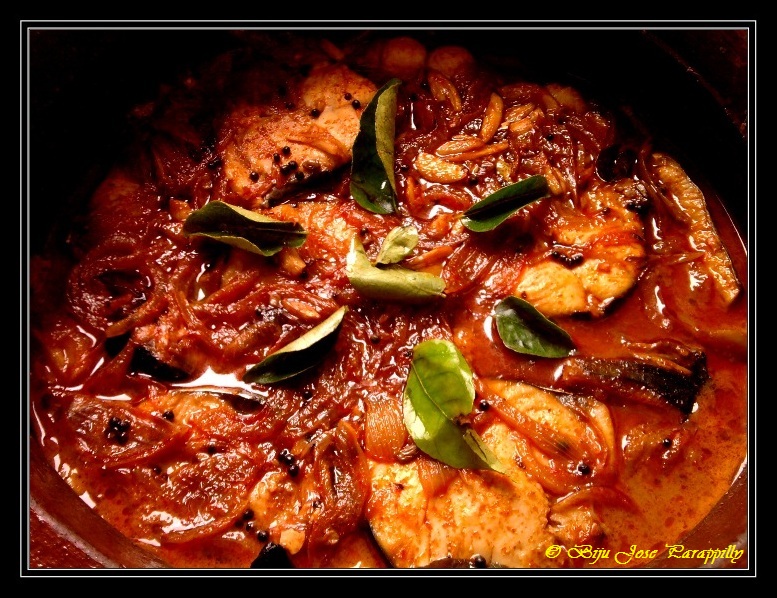
Kerala Red Fish Curry


This dish is supposed to be very hot. But you can adjust the degree of hotness according to your taste by using Kashmiri Chilly powder and by avoiding the green chillies. This also goes very well with steamed white rice/brown rice. This dish also has slight variations in different parts of Kerala.

Ingredients

  • Coconut Oil - 3 tablespoons. Use any other cooking oil if you are not comfortable with using coconut oil for cooking.
  • Mustard Seeds - ½ teaspoon
  • Fenugreek Seeds - ¼ teaspoon
  • Curry leaf - 2 sprigs
  • Green Chilly - 2 slit lengthwise
  • Ginger - 1" piece, thinly sliced
  • Garlic - 10-12 cloves, cut into two pieces each
  • Shallot - 1 cup, sliced thinly
  • Chilly Powder - 2 tablespoons
  • Turmeric - ¼ teaspoon
  • Kudampuli (Malabar Tamarind) - 3-4 pieces
  • Salt as per taste
  • Fish Fillets (Kingfish, Pomfret, Indian Salmon, Sardine, Mackerel etc.) - ½ kg
Method
  • Heat a pan and add the oil.
  • Once the oil is hot, add the mustard seeds and fenugreek seeds
  • Once the seeds splutter, add the ginger and garlic and fry for 1 minute
  • Add the curry leaves
  • Add the sliced shallots and fry till they are translucent
  • Add the green chillies
  • Mix the chilly powder and tumeric powder with a little water to form a thick paste. Add this to the pan. Fry the masala for about 2 minutes
  • Add a cup of water.
  • Once the mixture boils, add the fish and the malabar tamarind and salt.
  • Reduce the flame to a simmer and cook for 8-10 minutes
  • Take off from the stove and let the dish stand for 5-6 hours before using it.
Information & Tips
  • You can find what Malabar Tamarind is here. This is usually available in Kerala Stores (for those who stay outside of Kerala) and is available in most of the shops in Kerala. If you cannot find this, you can substitute this with kokum or tamarind pulp. But the taste will not be the same. This is one of the most important ingredients of this dish, that gives it its signature flavour.
  • Shallots are also called small onions, sambhar onions etc. and are widely available in South India. You can substitute it with normal onions.


  • Tapioca - 1 kg
  • Coconut oil (or any other cooking oil) - 3 tablespoons
  • Mustard seeds - ½ teaspoon
  • Turmeric Powder - ½ teaspoon
  • Curry leaf - 2 sprigs
Coarse Paste
  • Curry leaf - 2 sprigs
  • Coconut - ½ of one coconut
  • Sliced shallots - ½ cup
  • Sliced Ginger - 1" piece
  • Green Chilly - 2
Grind this to a coarse mixture without water. It should have the consistency of grated coconut.

Method

First Part
  • Clean the tapioca and cut into small bite-sized pieces. Clean it thoroughly.
  • Boil water in a pan and add some salt to it. Add the tapioca pieces and boil for 3-4 minutes. Drain the water off.
  • Add fresh hot water again and boil the tapioca till it is cooked. Drain off the water completely.
Second Part
  • Heat oil in a pan and once the oil is hot, add the mustard seeds.
  • Once the mustard seeds splutter, add the curry leaves and then the coarsely ground coconut mixture. Saute this for 3-4 minutes on medium flame.
  • Add salt and then turmeric.
  • Then add the tapioca and turn the flame to low heat
  • Mix everything well and cook for 3-4 minutes.
Serve with the fish curry made earlier.